
Listen to this guide
8 min · Read by Vesta, Braise's AI host.
Frames and joinery, weight ratings and hardware. How to spot a bench or cross that will last for decades, and how to plan the room around it.
Dedicated BDSM furniture is a serious purchase. A good bench or cross costs real money and ships by freight, and then it takes up a permanent spot in your home. Bought well, it lasts decades. Bought badly, it wobbles and squeaks, and it ends up as a very expensive thing to get rid of.
We own an obedience bench and a St. Andrew's cross, and most of what's below comes from living with them. The principles apply to almost any piece in this category.
Build quality comes first
Start with the frame, because everything else depends on it.
Material. Solid hardwood or welded steel usually outlasts particleboard and MDF by decades. Particleboard is fine for a bookshelf. It is not fine for something that takes a person's weight at unusual angles. If a listing doesn't say what the frame is made of, ask. Treat a vague answer as a no.
Joinery. Look at how the pieces come together. Bolted joints with metal inserts, or proper welds on steel, are signs of a piece built to last. Staples, wood screws into end grain, and glue alone are not.
Weight. A heavy piece is usually doing its job. If something that's meant to hold a person can be lifted easily with one hand, ask why. The same test applies to a sex machine's base, as choosing your first sex machine explains.
Stability and load ratings
A good piece doesn't move when you lean on it or shift your weight suddenly.
- Look for an explicit weight rating. A reputable maker states one. Choose a piece whose rating is comfortably above the heaviest person who'll use it, since movement adds force beyond body weight.
- Look at the base. A wide stance resists tipping. Narrow legs and a high center of gravity are a warning sign.
- Test for sway. Once it's assembled, push firmly at the top and sides. There should be no rocking or flex.
- Check the floor. A level, solid floor matters. Thick rugs can make a stable piece unstable.
If a piece is designed to mount to a wall, the wall becomes part of the structure. Mount it into studs with the hardware the maker specifies, or use a freestanding version. When you're not sure about your wall, ask a contractor.
Padding and upholstery
Padding should be dense and properly upholstered over a solid base. A thin layer of soft foam over a hard edge feels fine for a minute and uncomfortable after ten.
Upholstery choice is mostly about care:
- Vinyl is easy to wipe clean and handles regular use well. Good vinyl looks better than you'd expect. Cheap vinyl cracks.
- Leather is beautiful and ages well, but it needs regular conditioning and is harder to sanitize.
- Fabric is the most furniture-like but the hardest to keep clean, unless it has a removable, washable cover.
Our care page for leather and wood furniture covers upkeep for both.
Attachment points
The restraint points decide what a piece can actually do.
- Count them, and look at where they are. More, well-placed anchor points mean more versatility later. Points only at the corners limit you.
- Check how they're fixed. D-rings and eye bolts should be bolted through the frame, with a nut or plate on the other side. Hardware that's only screwed into the surface can pull out.
- Check the metal. Rated steel hardware, solid rather than plated pot metal. Gates on clips should close cleanly.
- Look for quick release. Restraints that attach with clips release faster than buckles. That matters in an emergency, and our guide to starting with restraints, safely explains why.
Footprint and delivery
These pieces are large, and most of them are unmistakable. Before you order:
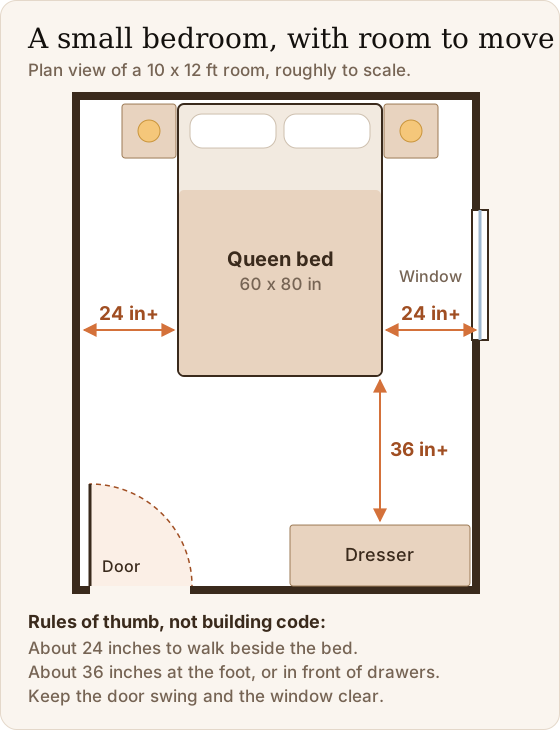
- Measure the room. Include clearance around the piece for moving, kneeling, and getting in and out. A piece jammed against a wall loses half its usefulness.
- Measure the route. Freight deliveries usually come to the curb or the front door. Check the stairs and doorways it has to get through.
- Plan the assembly. Some pieces arrive nearly complete. Others, crosses especially, take a real afternoon and two people. Read the instructions before the box arrives.
- Plan where it lives. A cross or frame will stay out. Decide in advance which room it's going in, and who else uses that room.
The Room Designer lets you place a piece in a plan of your real room to check the fit before you buy.
Where to buy
Specialist furniture makers and large adult retailers both sell this category, and quality varies a lot within each. Our review of Extreme Restraints, where we've ordered furniture ourselves, covers one of the deepest catalogs, and our store comparison lines up delivery and billing across several retailers.
For a piece that passes as fine furniture, look at boutique makers. The Stockroom spanking bench is an example of heirloom joinery in a piece that looks right in a well-furnished room.
If it's a gift for the two of you, gifts for the extra kinky collects the benches, swings and storage we've vetted.
Discretion and the room around it
A dedicated piece changes a room. If you share your home, think about:

- Visibility. Can it be seen from the door, or by guests? A lock on the door and a thoughtful layout help. Our guide to designing a discreet intimate space covers sightlines.
- Covering it. A fitted cover or a large throw turns a bench into an anonymous upholstered shape.
- Sound. Furniture that creaks or knocks against a wall carries. A rug under it helps, and so does leaving a gap between it and the wall. The soundproofing guide covers the rest.
- Style. Dark wood and leather sit naturally in The Study. Steel and black upholstery suit an Industrial Loft or Modern Noir room. A piece that matches the room's materials draws less attention than one that fights them.
If you only have one room to work with, the dual-use room guide shows how to make it switch between daytime and night. If you have a spare room to give it, see turning a spare room into a private retreat.
Common mistakes
Buying the cheapest version first. Cheap furniture in this category tends to fail in ways that matter. It's usually cheaper overall to buy one good piece than a bad one and then a good one.
Ignoring the weight rating. It's the one number that matters most.
Skipping the conversation. A new piece opens new possibilities, and those deserve the same talk as anything else new. Our guide to boundaries and safewords covers it.
Forgetting maintenance. Check bolts and hardware regularly. Wood shifts with the seasons, and bolts loosen with use. A two-minute check before use catches most problems.
Buy once and buy well. A solid piece, properly placed and looked after, will be part of the room for a very long time.
Scenes to try
All scenesScenes are ideas for an evening at home, each tied to a room style, with a pause word built in.