Listen to this guide
8 min · Read by Vesta, Braise's AI host.
Power range, noise under load, and where it lives between uses. What matters when buying a first sex machine, and how to use it safely.
Sex machines look intimidating on a spec sheet. Motor wattage, strokes per minute, connector standards, angle ranges. Most of those numbers matter less than they seem, and a few things that rarely make the headline matter a great deal.
We own and use two machines, the Hismith Premium Pro and the Motorbunny Buck, and they're very different from each other. Between them, they've taught us what to look for in a first machine and how to use one safely.
The main types
A sex machine is any device that provides powered, repetitive motion, usually thrusting. They come in a few broad shapes.
Thrusting machines on a base. A motor housing on a stand or frame, with an arm that moves an attachment back and forth. These are the most common and the most adjustable. The Hismith Premium Pro is one.
Saddle machines. A padded seat you sit astride, with vibration, a rotating or thrusting attachment, or both. They're used by the rider, who controls position with their own body. The Motorbunny Buck is a saddle with a thrusting option.
Compact and handheld thrusters. Smaller devices, sometimes rechargeable, that thrust without a stand. Easier to store and cheaper, but much less powerful and harder to keep in place.

Power and range come first
You want a wide, smooth range more than a dramatic top speed. What makes a machine pleasant to use is how gently it can start and how evenly it climbs. A machine that leaps between speeds in big steps is harder to enjoy than one with fine control at the bottom.
Things to check:
- Lowest speed. Can it go really slow? Most first sessions live in the bottom third of the range.
- Smooth steps. A dial or many small increments is better than a few big jumps.
- Torque under load. A machine that slows down or stalls when there's resistance is underpowered. Reviews that mention this are worth reading.
- Stroke length. Many machines let you adjust how far the attachment travels. A shorter stroke is a better starting point.
- Angle adjustment. Being able to change the angle and height of the arm makes a machine work for more positions and more bodies.
Noise matters more than people expect
Noise is the most underrated factor. A machine that's powerful but loud is one you'll use less, especially in a home with neighbors or children. Every motor sounds quieter on a table than it does under load, so look for reviews that test noise in use.
Think about where you'll realistically use it. A machine on a hard floor transmits sound and vibration. A thick rug or a mat under it makes a real difference. Shared walls are covered in privacy and soundproofing, sensibly.
Attachments and connectors
Attachments decide versatility and cleanup.
- Quick-swap connectors. A standardized, quick-release connector makes changing attachments simple and opens up a wider range. Hismith's KlicLok system is one well-known example, and it's a big part of why that machine is easy to live with.
- Body-safe materials. Look for silicone attachments. Cheap PVC or jelly attachments are porous and can't be properly cleaned. Our guide to body-safe materials and cleaning explains why.
- Start smaller. Use a smaller attachment for the first few sessions, even if bigger ones came in the box.
Remote and app control
App control or a remote is useful for couples, since it lets one partner run the machine while the other enjoys it. But the most important control rule applies to everyone: the person using the machine must be able to stop it instantly.
That means a remote or stop button within easy reach of them, every time. If a partner is controlling the machine, agree on a word or signal that stops it immediately, and make sure the controller is watching and listening. Boundaries and safewords covers how to set that up.
Stability and setup
A thrusting machine pushes back against its own base with every stroke. If the base isn't stable, the machine walks across the floor, or tips.
- Use it on a firm, level surface.
- Check that any legs, clamps, or suction feet are secure before you begin.
- Position the machine before you start it, rather than adjusting it while it's running.
- Keep cords out of the way, and keep the machine and its power supply away from water unless it's rated for it.
Positioning furniture helps a lot. A wedge or ramp puts the body at the right height and angle so nobody has to hold an awkward position. Our guide to choosing positioning furniture covers the options.
Using one safely
- Start slow and short. Lowest speed, shortest stroke, smallest attachment. Build up over sessions, not minutes.
- Use plenty of lube, and reapply. Machines don't get tired, so friction builds up faster than with a partner. Water-based lube is safe with silicone attachments. Our lube guide explains the pairings.
- Keep the stop within reach. Always.
- Check the attachment before you start. It should be firmly locked onto the connector.
- Stop if anything hurts. Discomfort is a signal to slow down or stop, not to push through.
- Never combine restraint with a machine you can't stop yourself. If someone is restrained, a partner must be present and controlling the machine the whole time.
Cleaning and storage
Wash attachments after every use with mild soap and warm water, and let them dry fully. Some silicone attachments can be boiled. Check the maker's instructions. Wipe down the machine body and arm with a damp, soapy cloth, keeping water away from the motor and controls.
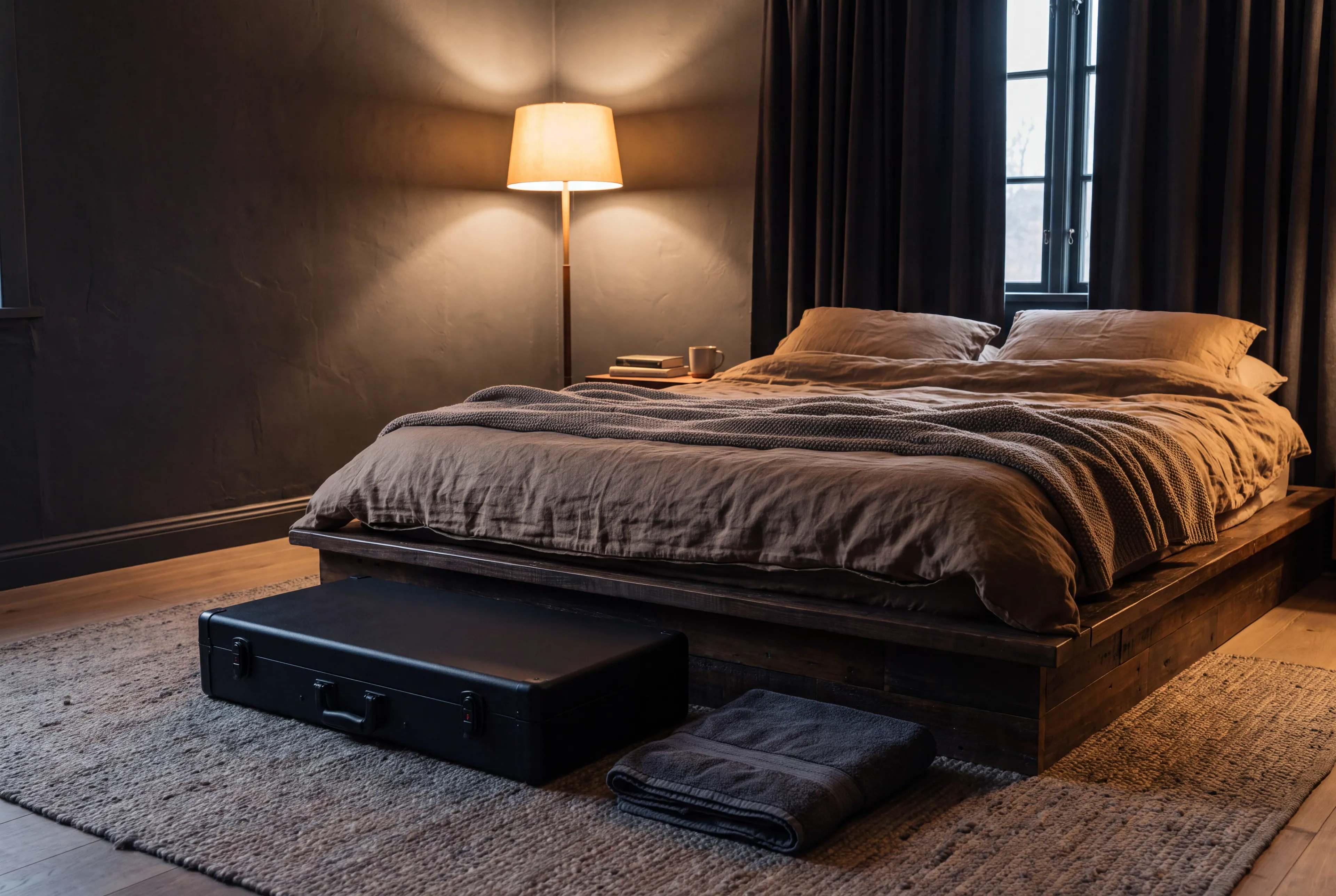
These are large pieces. Think honestly about where yours will live between uses. A machine that breaks down or tucks under the bed will get used more than one that has to be hidden in a hurry. Store attachments separately in pouches so they don't touch each other. Our guide to designing a discreet intimate space has storage ideas.
A short buying checklist
- Does it start very slow, and step up smoothly?
- How loud is it under load, according to people who've used it?
- Does it use a standard, quick-swap connector?
- Are the attachments body-safe silicone?
- Is there a physical remote or stop button as well as the app?
- Is the base stable, and adjustable for angle and height?
- Where will it live when you're not using it?
If you're shopping as a couple, read introducing something new, together first. You'll find the machines we recommend in The Edit.