Listen to this guide
7 min · Read by Vesta, Braise's AI host.
Firm wedges and ramps fix angles and take strain off backs and knees. How to pick the right shape, and how to choose one you can leave out.
Positioning furniture solves a problem most people don't realize they have until it's solved. Beds are flat and soft, and bodies aren't. A firm cushion at the right angle takes strain off backs and knees, and it makes some positions possible that would otherwise need someone holding their weight. That's all it is, and it's surprisingly useful.
Here's what to look for and which shape to start with, then how to choose a piece you'll be happy to leave out in the room.
Firmness is the whole job
The single most important attribute is firmness. Soft foam collapses under weight and does nothing. A pillow you sleep on flattens to a couple of inches the moment someone leans on it. High-density foam holds its shape under two people and keeps the angle you bought it for.
When you compare pieces, read for foam density before dimensions. A maker that states the density, or says "high-density" and describes how it holds up, is usually confident in it. Reviews that mention how a piece felt after months of use are worth more than first impressions. We've used the Liberator Wedge/Ramp combo at home for a long time, and the foam is the reason it's still on our bed.
The main shapes
Wedge
A firm triangle, usually placed under the hips or lower back. It tilts the pelvis, which changes angles and takes pressure off the lower back for the person lying on it. A wedge is the easiest entry point. It's also the cheapest piece and the most discreet.
Ramp
Longer and lower than a wedge, with a gentler slope. It supports more of the body, which makes it comfortable for longer, and it adds height. A ramp is particularly useful when partners are different heights, or when the bed is lower than ideal.
Wedge and ramp together
Stacked, they create a raised, angled platform that neither one manages alone. That's why they're often sold as a pair. If you're likely to want both eventually, the combo is usually better value.
Bolsters and cylinders
Round or half-round cushions that support the small of the back or the knees. They're the most furniture-like of all, since every decorator puts a bolster on a bed anyway.
Cubes and stools
Firm, padded blocks that add height off the edge of the bed or the floor. Useful, but harder to disguise.
Chaises
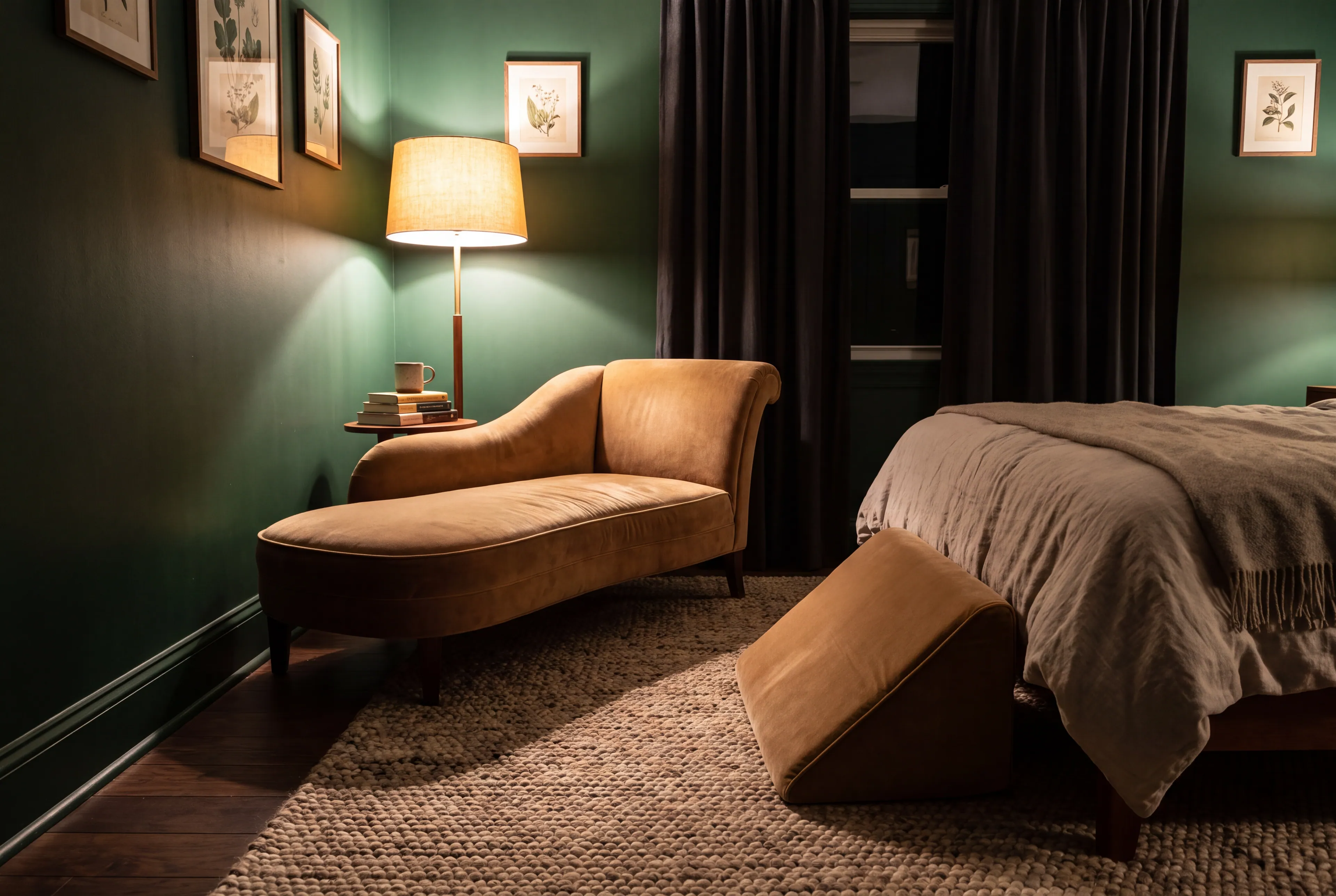
A curved lounge that supports the body at angles a bed can't. The Liberator Esse chaise is the best-known example, and in a good fabric it reads as a designer lounge chair. A chaise is a statement piece and proper furniture. It also takes real floor space.
Matching the shape to what you need
- You want to try one thing first: a wedge.
- Back pain, hip pain, or limited mobility: a wedge or ramp, to take the work off joints. Our comfort-first guide has more on adapting for the body.
- Different heights, or a low bed: a ramp, or the combo.
- You want furniture that's also a reading chair: a chaise.
- You have very little storage: a wedge or bolster that lives on the bed.
Bigger isn't better. Match the piece to your bed height and the space you have to keep it.
The cover matters more than you'd think
Positioning furniture gets used in the moments when lube and oil get everywhere. A cover that can't be washed becomes a problem quickly.
Look for:
- A removable, machine-washable cover. This is close to essential.
- A durable fabric. Microfiber and performance velvet clean well, hold up to washing, and look like ordinary upholstery.
- A moisture-resistant inner liner. It sits between the foam and the cover and protects the part you can't wash.
- A grippy base. Some pieces have a non-slip panel underneath so they don't slide on sheets.
Spare covers are worth buying if the maker sells them. One in the wash, one on the piece. Our positioning furniture care page covers washing and drying.
Discretion: buy something you'll leave out
A piece that only works hidden in a closet gets used less. The best positioning furniture reads as an ottoman or an accent chair when it's dressed and sitting in the room. That's what dual-purpose furniture means at its best.

A few things help a piece blend in:
- Color. Mid-tones and darker fabrics look like furniture. Bright red or shiny black looks like what it is.
- Placement. A wedge on the bed with the pillows looks like bedding. The same wedge alone on the floor doesn't.
- Dressing. A throw over a ramp, or a decorative cushion on a chaise, finishes the disguise.
- Branding. Remove any visible tags.
Our guide to designing a discreet intimate space covers how to fit these pieces into a bedroom without them standing out.
How to use it the first time
Start simple. Try a wedge under the hips of whoever is lying down, and adjust from there. Small changes in position make a big difference, so move it an inch or two before deciding it doesn't work. Use the edge of the bed. Many of the best uses involve one person on the bed and one standing or kneeling beside it.
Pair it with the right bed. A firm mattress holds a wedge better than a soft one, and a bed with room to move makes everything easier. Our guide to choosing a bed size covers that. If restraints are part of your plans, a wedge pairs well with an under-bed system.
Common mistakes
Using sleeping pillows instead. They compress and slide. A firm piece is the difference.
Buying the biggest piece first. A wedge you use every week beats a large piece that lives in the garage.
Ignoring the cover. A piece you can't wash easily is a piece you'll stop using.
Hiding it. If you bought something you're not comfortable leaving out, plan for a spot where it can stay, or choose a smaller piece.
The positioning pieces we recommend are collected in The Edit.
In the glossary: Positioning furniture, Wedge