
Listen to this guide
7 min · Read by Vesta, Braise's AI host.
Desire and bodies change over the decades, but closeness has no expiration date. Practical ways to adapt comfortably, and when it's worth talking to a clinician.
General information, not medical advice. For anything specific to your body or your health, talk to your own clinician.
Intimacy doesn't retire. Desire and stamina change over the decades, and so do bodies, but the need for closeness and touch carries on for life. Plenty of people find their intimate lives in later years become less about performance and more about connection, with more time and less hurry, and fewer things to prove.
Here we look at the changes many people notice and how to adapt for comfort, and at when it's worth a conversation with a clinician. It's general information. Your own clinician knows your health and your medications, and they're the best person for specific questions.
What often changes
Everyone ages differently, but a few changes are common enough to expect.

- Arousal takes longer. For people of every body type, the body may need more time and more direct stimulation to warm up.
- Natural lubrication decreases after menopause, and vaginal tissue can become thinner and more sensitive. Our guide to intimacy through menopause covers this in detail.
- Erections may be less firm, take longer, or be harder to keep. They may also take longer to return afterward.
- Orgasms may feel different, sometimes less intense, sometimes just different.
- Joints and backs complain more, which makes some positions uncomfortable.
None of this means intimacy is over. It means the approach changes.
Adapting for comfort
Slow down
A slower, more patient pace suits most bodies better with time. Longer warming up and more touch before anything else make a real difference to comfort and pleasure. Many couples find this is one of the nicer changes.
Use lube, generously
Extra lubrication is a simple change that does a lot. A good water-based or silicone lube makes things far more comfortable. Our guide to choosing and using lubricant explains the options and which ones work with toys.
Support the body
This is where a firm wedge or ramp earns its keep. Positioning furniture takes strain off backs and hips, so comfort leads and nobody has to hold an awkward position. Our guide to choosing positioning furniture covers the shapes. Side-lying positions, with pillows between the knees, are often the most comfortable of all.
Let toys help
Vibrators can help with arousal when the body needs more stimulation than it used to. If direct vibration feels like too much, air-pulse vs vibration explains a lighter, indirect option. A wand with a long handle is easier on stiff hands and wrists. A broad, rumbly external vibrator like the Dame Com is easy to hold. If toys are new to you both, our guide to introducing something new, together has ideas for bringing one up.
Choose your time
Many people feel best at a particular time of day. If mornings are when you're rested and less stiff, that's when. A warm bath or shower beforehand loosens muscles too.
Comfort first goes further on adapting for pain or limited mobility.
Health and medications
Many common conditions affect intimacy. Heart disease and diabetes are well-known examples, and arthritis and depression play a part for many people. Plenty of everyday medications do too, including some for blood pressure and some for mood. Side effects can include lower desire, difficulty with arousal or erections, and dryness.
This is ordinary, and nothing to be embarrassed about. It's also well worth raising with a clinician rather than assuming it's simply age. A clinician can often adjust a dose or switch a medication, and may suggest something else that helps. Don't stop or change a medication on your own.
A few specific points:
- Erection medications are widely used, but they aren't safe for everyone, especially alongside some heart medications. Get them through a clinician who knows your full medication list. Avoid buying them online without a prescription.
- Vaginal dryness and thinning have effective treatments beyond lube, including options a doctor can prescribe.
- Pain during sex isn't something you have to accept. Tell a clinician, and ask about pelvic floor physical therapy if it's relevant.
- After a health event like a heart attack or surgery, ask your care team when it's safe to resume sex. Finding your way back after illness or surgery covers that conversation.
Safer sex at any age
The risk of sexually transmitted infections doesn't end with age. Pregnancy may no longer be a concern after menopause, which can make it easy to forget about condoms. If you have a new partner, use condoms and consider getting tested together. Clinicians are used to these conversations with people of every age.
New partners later in life
Many people find themselves dating again later in life, after divorce or the loss of a partner. That can be exciting and nerve-wracking at once. Go at your own pace, talk openly about what you each want, and don't assume a new partner's expectations match yours. Our guide to talking about boundaries is useful at any age.
Set up the room for comfort
A few small changes to the bedroom help:
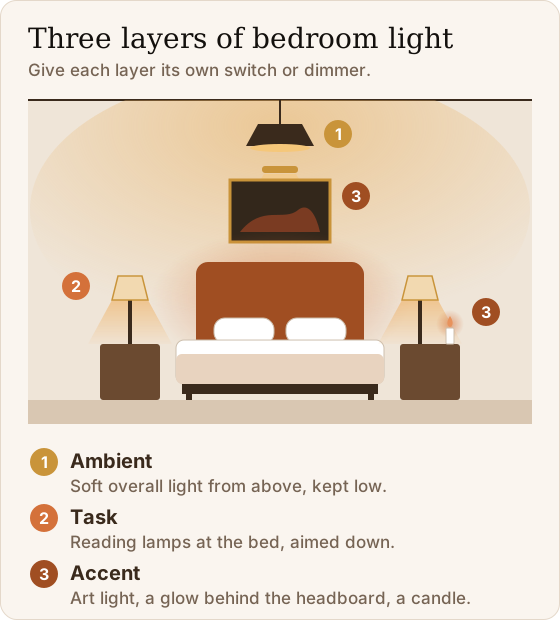
- A comfortable bed height makes getting in and out easier, and makes positions at the edge of the bed possible.
- A supportive mattress helps sore backs. For the bed itself, see choosing a bed size.
- Warm, low lighting with enough to see by. Soft lamps instead of a harsh overhead, plus a nightlight on the way to the bathroom for safety.
- Everything within reach. Lube, water, and pillows close by.
Connection is the constant
Affection and humor keep intimacy warm whatever bodies are doing on a given day. Shared rituals do too, along with honest conversation about what feels good now, which may not be what felt good twenty years ago. Touch that isn't heading anywhere in particular counts as much as anything else.
The couples who stay close are the ones who keep talking and keep touching. They let the definition of intimacy grow with them. Our conversation cards can help start new conversations, and the habits in keeping connection alive in a busy life work at any stage.
- National Institute on Aging: sexuality in later life
- Mayo Clinic: sexual health & aging
General education, not medical advice. See our editorial standards.
Scenes to try
All scenesScenes are ideas for an evening at home, each tied to a room style, with a pause word built in.